

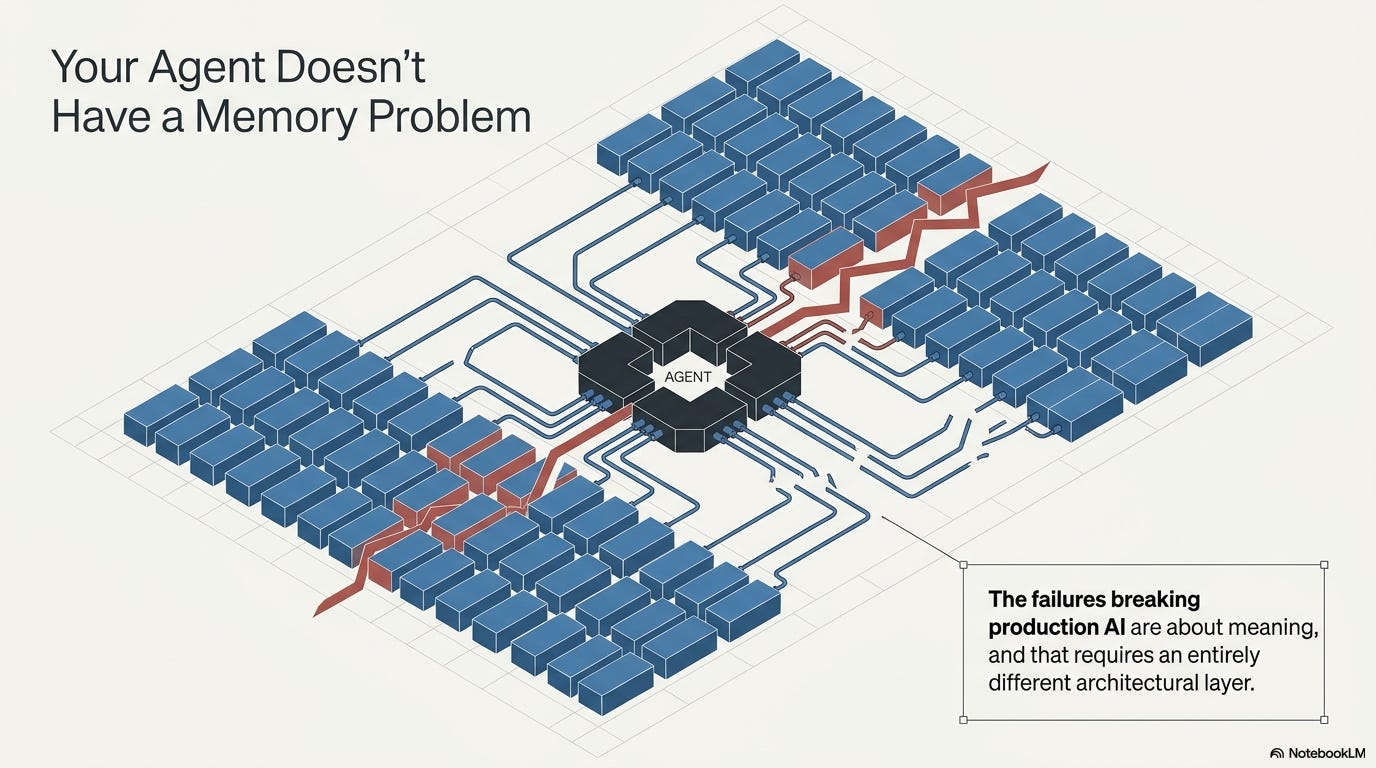
The pitch for agent memory is clean. An agent that forgets everything between sessions is a goldfish - give it a memory and it finally becomes a colleague. Half the tooling that shipped in the last year sells some version of that promise. It’s a real improvement. It is also not the thing standing between today’s agents and the work you actually want them to do.
The teams putting agents against real business data keep hitting the same wall, and it isn’t forgetfulness. The agent remembers fine. It pulls back the right-looking documents, quotes the right-sounding numbers, and gets the meaning wrong -confidently. That gap, between remembering something and understanding it, is the most useful thing to get straight about agent architecture right now.
Memory solves statelessness, not meaning
Strip away the branding and “memory” for an agent is two things: persistence and retrieval. You write the important bits of a session somewhere durable, and next time you fetch the relevant bits back. That genuinely fixes the goldfish problem. A coding assistant that recalls your project’s architecture, a support agent that remembers a customer’s last three tickets - this is worth having.
But look at how retrieval works. Almost every memory system ranks stored fragments by similarity - how close a chunk sits to your query in embedding space - and hands the top matches to the model. The industry’s own taxonomy is honest about this division of labor: memory handles continuity across sessions, retrieval handles broad document lookup, and a knowledge graph handles structured reasoning - three different jobs. Memory does the first one well. It does not do the third one at all.
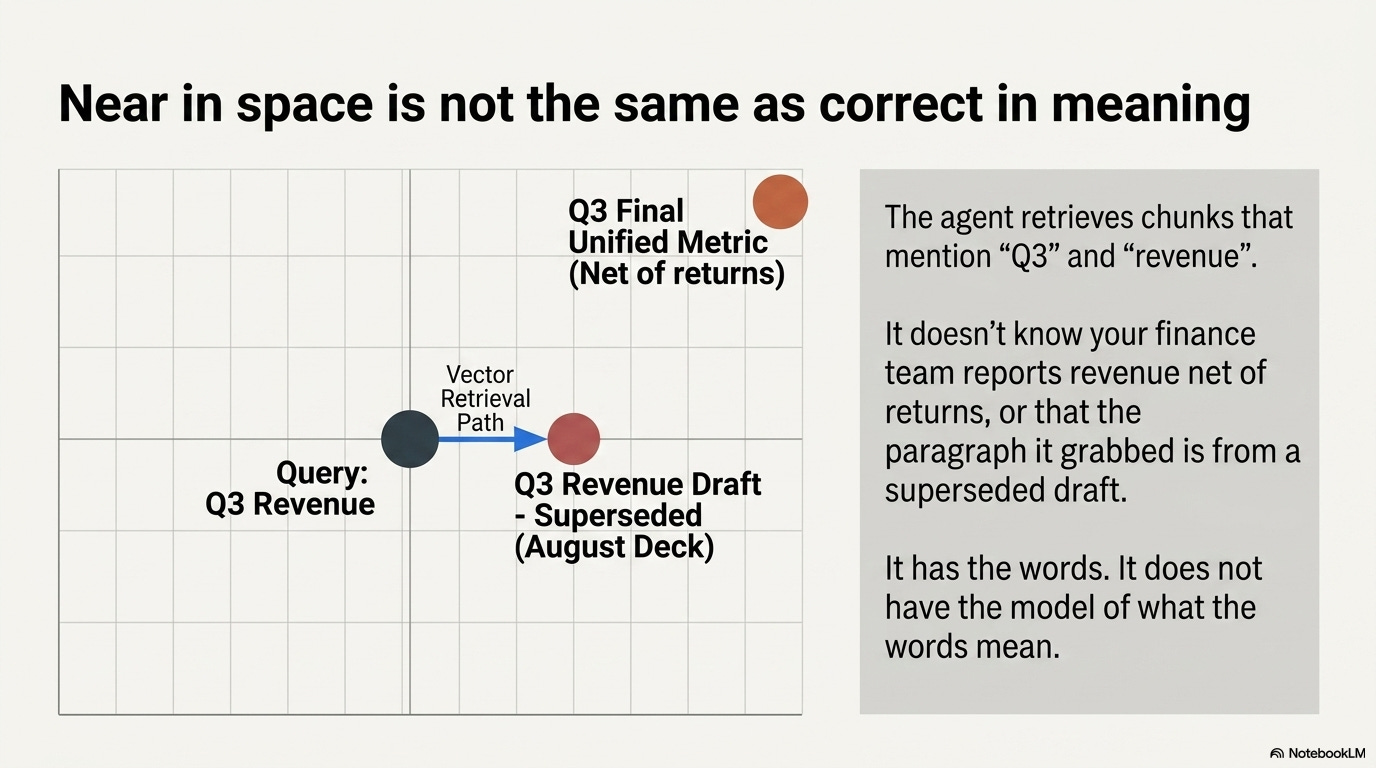
Memory hands back fragments ranked by similarity - what sits nearby in embedding space, not what happens to be true.
Near in embedding space is not the same as correct in meaning. Ask an agent about Q3 revenue and it will happily retrieve chunks that mention “Q3” and “revenue.” It will not know that your finance team reports revenue net of returns, that the “Northeast region” in the August deck is not the “Northeast region” from the reorg two weeks later, or that one of those confident-looking paragraphs is from a superseded draft. It has the words. It does not have the model of what the words mean. Memory gave it recall. Recall was never the hard part.
The naive fix makes it worse
The obvious response is to retrieve more - turn up the number of chunks, or skip retrieval entirely and pour everything into one of the million-token context windows the model vendors keep advertising. Just give it all the memory. Let the model sort it out.
In mid-2025, Chroma published a study it called context rot: across 18 (back then) frontier models - the GPT-4.1, Claude 4, Gemini 2.5, and Qwen3 families among them - performance degraded as input length grew, on tasks as simple as finding a fact and repeating it back. The decline started well before the window was anywhere near full. And the sharpest finding for our purposes: the models got worse when the irrelevant text was semantically similar to the answer, because similar-looking distractors are the hardest ones to ignore.
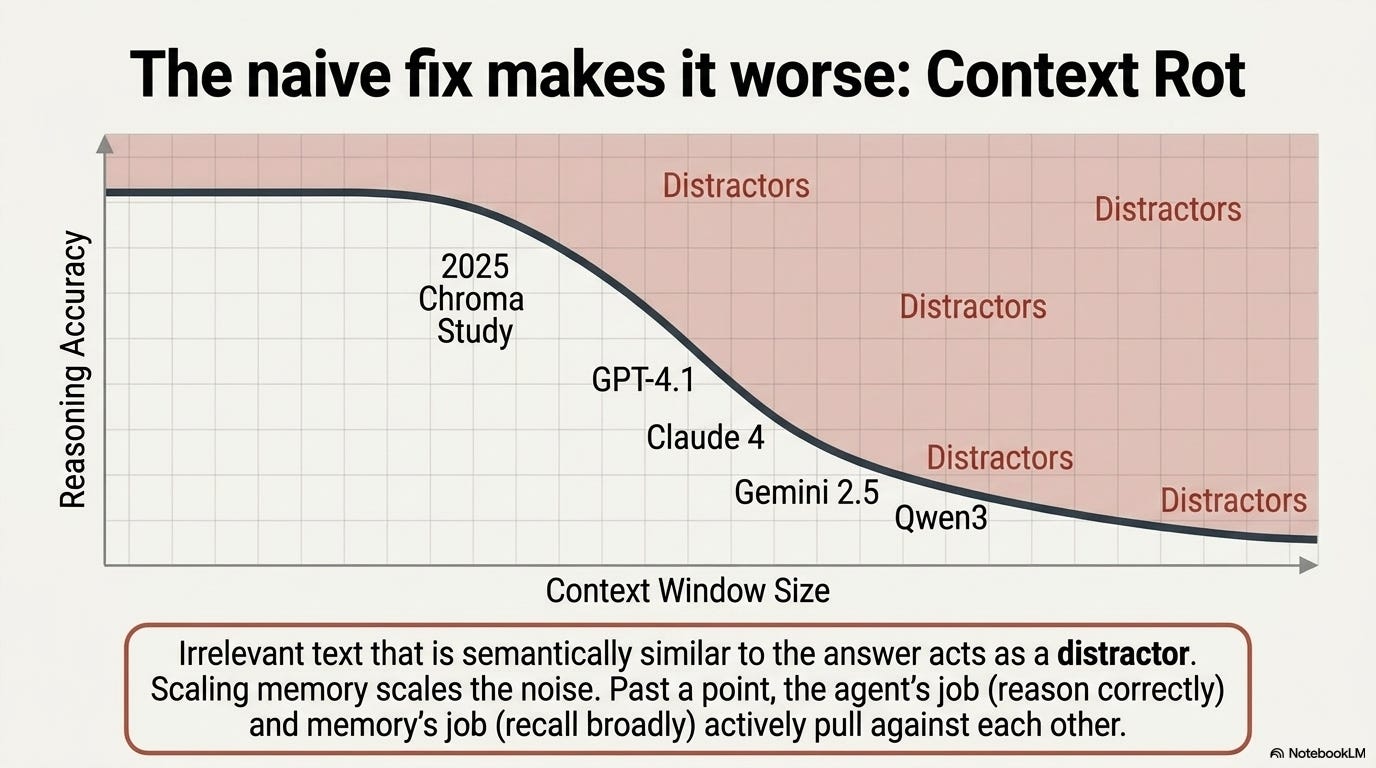
Why “just add more memory” backfires: past a point, extra tokens are extra distractors, and signal drowns in similar-looking noise.
Every fragment your memory system retrieves that is relevant-looking but wrong is a distractor competing for the model’s attention, and the more of your domain sounds alike - every quarter’s revenue deck, every region’s postmortem - the more of those distractors you’re feeding in. What determines quality isn’t how much you can store; it’s the signal-to-noise ratio of what you pull. So scaling memory scales the noise along with the signal. Past a point, the agent’s job (reason correctly) and memory’s job (recall broadly) actively pull against each other.
A fair caveat: Chroma sells retrieval infrastructure, so it has a house interest in “bigger windows aren’t the answer.” But the broader effect it’s pointing at -degradation in long context, the “lost in the middle” problem - is documented well beyond Chroma, and the mechanism is the kind you can feel in any system you’ve actually run. More context is not more understanding. Often it’s just more ways to be wrong.
The tier you’re actually missing
If memory is storage and retrieval is fetching, the thing sitting between raw fragments and a correct answer is meaning - and that’s a distinct architectural layer with its own name. A semantic layer is a governed model of what your entities, metrics, and relationships actually are: the shared vocabulary your whole stack agrees on before anyone, human or agent, asks a question.
Two different streams have been converging on that idea, and both versions of the concept bring something valuable to the table. First, let’s take a look at them independently:
The first comes from the data world, where a semantic layer has meant one thing for years: the governed place where business definitions live above the raw tables, so that “revenue” or “active customer” resolves to the same number in every tool and every dashboard. This is the old problem of Marketing and Finance quietly using two different definitions of the same word - and it’s mature enough that Gartner elevated the semantic layer to essential infrastructure in its 2025 Hype Cycle for BI and Analytics, and now projects that universal semantic layers will be treated as critical infrastructure for enterprise AI by 2030.
The second comes from the knowledge-graph world, where the “layer” is entities and the explicit relationships between them rather than metric formulas. Instead of a bag of text chunks, you store that this contract belongs to this account, which is owned by this rep, and supersedes that earlier contract. This is the structure behind GraphRAG and behind memory systems like Zep, whose Graphiti engine models memory as a temporal knowledge graph rather than a flat vector store. The payoff shows up exactly where vector search struggles: on multi-hop, cross-document reasoning. A 2026 benchmark over the Code of Federal Regulations - a domain full of “see the amended version of this clause” indirection - reported a 70% accuracy gain from a knowledge-graph approach over standard vector RAG. That’s a single hard-case study, not a universal law, but it points the right direction: the harder the relationships, the more structure becomes a differentiator.
Different tools, same underlying job. Both answer the question memory can’t: what does this thing mean, and how does it connect to everything else? That is the interpretation tier, and retrieval quietly skips it.
You don’t always need one
This is where the honest version of the argument has to slow down, because “add a semantic layer” is not free and plenty of agents don’t need it.
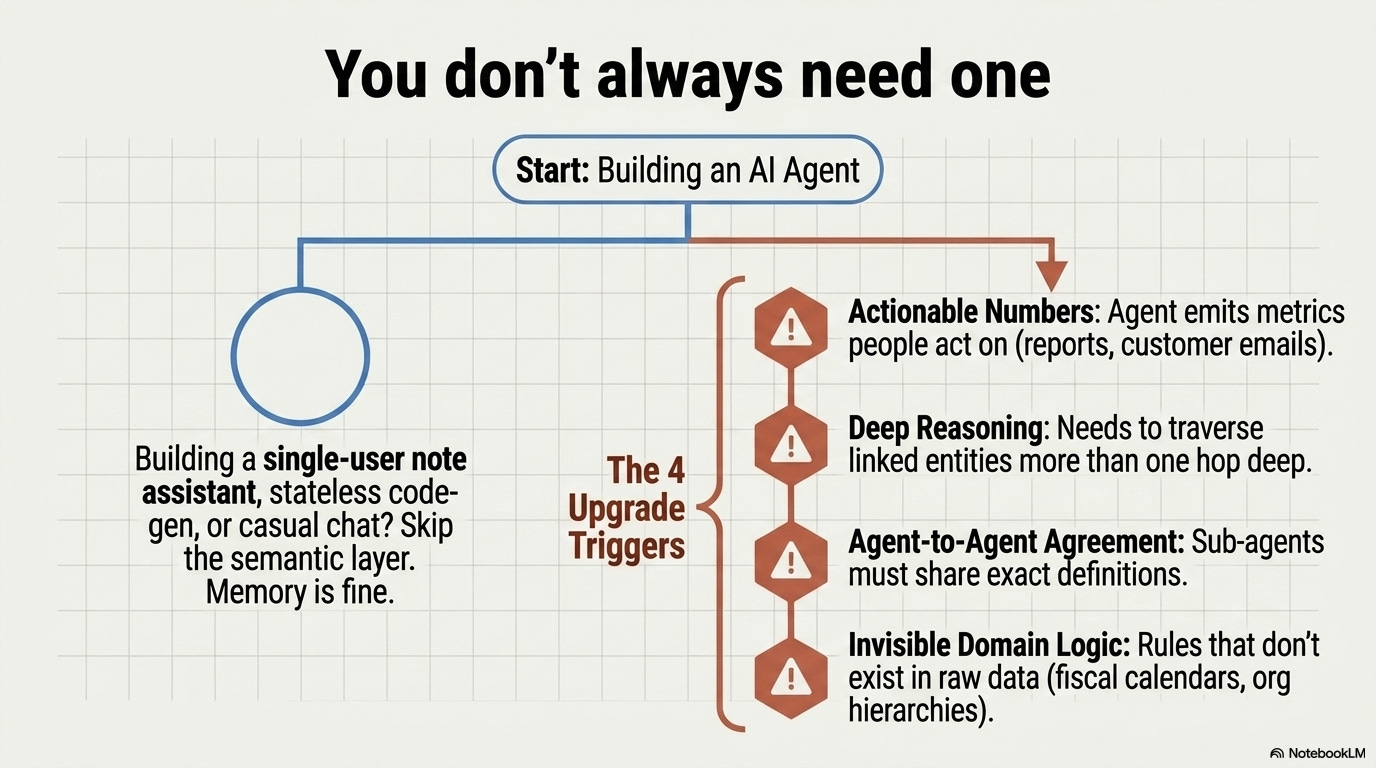
If you’re building a single-user note assistant, a stateless code-generation tool, or a chat interface where nobody downstream acts on a specific number, a semantic layer is overhead you can skip. Memory, or even nothing, is fine. The layer earns its cost under four conditions, and it’s worth checking whether any of them describe your system:
The agent emits numbers people will act on - a metric in a report, a figure in a customer email - where computing it two different ways is a real error, not a cosmetic one. The agent has to reason across many linked entities, following relationships more than one hop deep. Multiple agents or tools have to agree on definitions, so a sub-agent doesn’t compute “churn” differently than the orchestrator expects - a live concern now that agent-to-agent protocols push work across specialized agents. Or your domain carries definitions that simply don’t exist in the raw data: fiscal calendars, org hierarchies, the internal meaning of “enterprise tier,” which regulation supersedes which.
Make it concrete. A support agent handles a refund request. In the memory-only design, it retrieves the customer’s history and the refund policy, reads that the order total was $40, and issues the refund - but “order total” in that chunk was the pre-discount subtotal, and the policy it grabbed was last year’s, since both matched the query beautifully. With a semantic layer in the path, “refund amount” is a defined quantity with one calculation, and “current policy” is a governed entity with a status, so the wrong versions aren’t even eligible to be retrieved as truth. Same memory underneath. The difference is that meaning stopped being something the model had to guess from whatever text came back.
How the layers stack
The practical architecture is not memory or a semantic layer. It’s memory plus one, wired in order.
At the bottom sits the storage tier: a vector store for unstructured recall, plus an agent-memory system to manage what persists across sessions - Mem0, Zep and its Graphiti graph, and the growing field around them. On top of that sits the semantic tier, and which flavor you reach for depends on the job. For metric consistency, the mature options are the pure semantic layers - dbt’s Semantic Layer, Cube, and AtScale - now joined by warehouse-native versions like Snowflake’s Semantic Views and Databricks’ Metric Views, and BI-native ones like Looker’s LookML. For entity-and-relationship reasoning, it’s a knowledge graph - Neo4j, Fluree, or a GraphRAG pipeline. Then the whole thing gets exposed to agents through an API or, increasingly, through MCP, so the agent queries governed meaning instead of raw rows.
The shape of the fix: a storage-and-memory tier at the base, a governed semantic tier above it, and the agent querying meaning on top.
One development worth watching, because it changes the buying calculus: the Open Semantic Interchange, a 2025 effort in which dbt Labs, Snowflake, Salesforce, and others agreed to a vendor-neutral format for semantic definitions, with dbt’s MetricFlow as the spec. If it holds, you define meaning once and every tool - and every agent - reads the same definitions, instead of re-encoding your business logic inside each runtime.
The test that tells you which layer you’re missing
Here’s the diagnostic I’d actually run. The next time your agent states a number or names an entity, ask where the definition came from. If the answer is “whatever chunks the retriever returned,” you have a memory layer and no semantic layer - and you’re one plausible-looking distractor away from a confident, wrong, and hard-to-audit answer.
Fixing that doesn’t mean modeling your whole company on day one. The most sober advice in this space is to start with a handful of disputed metrics rather than a full taxonomy - twenty definitions people actually fight over beat five hundred nobody validated. Governed meaning is the part that compounds, storage is the part that’s already commoditized.
Two honest caveats to hold alongside all of this. A lot of the loudest “you need a semantic layer” voices are vendors who sell semantic layers. The reported figure that roughly 40% of enterprise leaders now see missing semantic context as a major blocker for operational AI is exactly the anxiety that moves the product - so discount the volume and check the mechanism, which is the part that’s real. And the two streams we’ve discussed, metrics and graphs, are still merging → the tooling to serve both to an agent through one clean interface is young and moving monthly. Hold these patterns firmly and update them often.
But the core of it is stable enough to bet on. Memory gives an agent recall. Recall was the easy 80%. The expensive failures live in the other 20 - the part where the agent had the right words and the wrong meaning - and no amount of memory reaches that. Meaning is a layer you build, not a byproduct of remembering more.
The "near in embedding space ≠ correct in meaning" framing is the cleanest version of this I've seen. One field note to back it, from ~25 years building software inside banks: your refund-agent example isn't a hypothetical there, it's Tuesday. The same word has carried two different numbers for decades: Finance's "revenue" net of returns vs. the deck's gross, Risk's "exposure" vs. the front office's. The metrics council and the data dictionary were the semantic layer before anyone gave it that name. What's new isn't the ambiguity, it's that an agent industrializes it at machine speed and states the wrong version with total confidence. Your "invisible domain logic" trigger, which regulation supersedes which, fiscal calendars, org hierarchy, is exactly where governed meaning stops being optional. Storage was never the hard part in a bank. Agreement was.
I usually like these posts but this one is _really_ hard to read:
"Sit with the mechanism, because it’s the reusable part." -- what does this even mean?
"Two lineages are converging on that idea, and it’s worth seeing both." this is not a human communicating, it's claude opus 5.
too much for me