

This Week on the Frontier
Mistral released new speech-to-text and text-to-speech models plus a voice agent SDK, built on LiveKit, that streams transcription, an LLM with tool calls, and speech output as one pipeline. Mistral reports turns under one second, transcription in 50+ languages at $0.0035/min for the Mini model, and speech at $13 per 1M characters, on its EU-hosted API or self-deployed. The benchmark charts are Mistral’s own.
LLMs are making formal software verification feasible at a much larger scale
Anthropic and Theorem had Claude prove that 239 fuzz entry points in 123 OSS-Fuzz libraries never crash for any input under 64 MB, producing about 180 million lines of Rocq over compiled RISC-V binaries. The work surfaced bugs that fuzzing had missed. The proofs assume single-threaded static RISC-V binaries on Linux with musl, while most deployments run x86 or ARM with glibc.
OpenAI models are coming to Google Cloud
OpenAI’s announcement says its frontier models and Codex workflows are coming to Model Garden, sold through Google Cloud Marketplace. Enterprise clients that buy through Google Cloud contracts can add OpenAI models without a separate vendor agreement. The announcement summary gives no model list, pricing, regions or data-residency terms, so those questions stay open for procurement teams.
Patch the Planet: global response coordination as agents uncover critical vulnerabilities
OpenAI launched Patch the Planet, a program connecting security researchers, maintainers and incident responders to fix critical open-source vulnerabilities as AI agents find them. The announcement describes a coordination program and reports no counts of vulnerabilities handled. Read next to Anthropic’s verification work, it suggests labs expect AI-found bugs to arrive faster than maintainers can triage them.
LEV: Thinking Fast and Deep with Looped Decision Models
What problem does it solve?
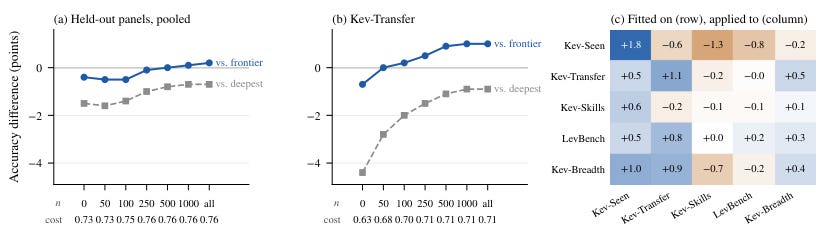
Decision models such as Jev and Kev answer questions with a fixed set of options by returning one probability per option from a single forward pass, in tens of milliseconds. Their depth is fixed at training time, so an easy question costs as much as a hard one. On the 231 public JevBench items, Kev-4B answers 28 more items correctly than Kev-0.8B, all from the standard and hard tiers. Generated reasoning on a DiffusionGemma 26B base raises hard-tier accuracy by 9 to 13 points but makes the median hard item three to four times slower, and easy questions pay for reasoning text too. Cascades reread uncertain questions and need a second hosted model. A loop retrofitted onto Qwen3.5-0.8B moved accuracy by less than half a point.
How does it solve the problem?
LEV, from Lehigh University with the University of British Columbia and the Vector Institute, starts from language models pretrained as loops: Ouro-1.4B and Ouro-2.6B, which rerun their layer stack four times, and Nanbeige4.2-3B, which runs it twice. A shared pointer head scores the options after every loop step, and training averages the loss over all steps with a rank-16 LoRA adapter. One checkpoint answers at any depth, depth k costs about k/R of the full pass, and an extra step resumes from the previous hidden states without rereading the input.
The usual early-exit rule is a confidence threshold tuned on labelled data. It fails here because shallow readouts are overconfident on new data: questions LEV-2.6B stops at depth one are 94.8% correct on the calibration partition but 78.9% correct on Kev-Transfer at almost the same confidence. LEV’s stopper, a small per-depth logistic regression, instead predicts whether the current answer agrees with the model’s own deepest answer. Its threshold is the cheapest one that keeps at least 98% agreement on unlabelled requests. About 500 unlabelled questions per fold bring LEV-2.6B within 0.2 points of the full fit.
What are the key findings?
LEV-2.6B rises from 63.2% at depth one to 76.2% at depth four on JevBench with the same weights, level with the released Kev-4B at 75.8%.
The stopper spends 1.2, 2.4 and 3.0 steps on easy, standard and hard JevBench items without seeing the tier.
On-demand depth saves 15% to 24% of computation for under one point against the deepest readout. Against a fixed mix of depths at equal cost, the locked-test gain is +0.1 points for LEV-2.6B and +0.9 for LEV-3B.
Below 50 ms, LEV-1.4B and LEV-3B are 5.4 to 8.8 points more accurate than dense models and cascades of the same latency. Part of this comes from no dense option answering between 22 and 79 ms, and in FLOPs LEV is at or below the dense options, not ahead.
Cost is counted in loop steps and latency was measured one request at a time, so batching mixed depths may shrink the wall-clock saving. On LevBench, 12.6% of questions are right at a shallower step and wrong at the deepest, which an agreement-based stopper cannot recover.
Why does it matter?
For fixed-option work such as routing, policy checks and classification into enums, LEV turns depth into a per-request setting on one checkpoint instead of a choice between two hosted model sizes. The stopper recipe also applies elsewhere: fit early exit to agreement with your deepest model on unlabelled production traffic, since labelled calibration sets drift from live data. Count the gain as latency, not FLOPs. The code is public on GitHub under Apache-2.0. LEV is the subject of this week’s video and deep dive, both published on Wednesday.
Has GPT-6-Astra Achieved Embodied Intelligence?
What problem does it solve?
Robotic manipulation and navigation have been the domain of specialized models trained per task and embodiment, such as vision-language-action models (VLAs). A joint research team led by SenseNova tests how far a general frontier model, GPT-6-Astra, goes as a robot controller, and measures what separates its benchmark scores from use on physical robots.
How does it solve the problem?
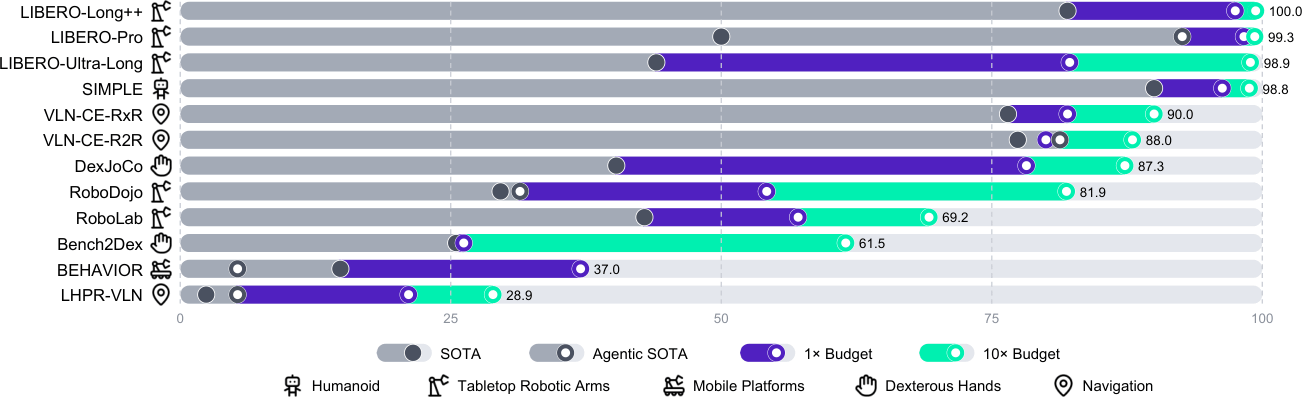
The study has four parts. In simulation, across 12 benchmarks covering tabletop arms, dexterous hands, a humanoid, household tasks and navigation, the weights stay frozen. Before testing, the model studies each task’s training demonstrations and writes a frozen knowledge package: task guidance, motion and visual references, Python helpers for kinematics, completion checks and recovery procedures. Episodes run at the official step budget and at up to 10x. Second, harness ablations on RoboDojo pair GPT-6-Astra as a slow ‘System 2’ with a fine-tuned π0.5 VLA as ‘System 1’, either issuing subgoals open-loop or reviewing the VLA’s proposed end-effector actions before execution. Third, zero-shot runs on 8 real robot platforms use human-written context and a 60-minute wall-clock budget. Fourth, a household prototype in NVIDIA Isaac Sim keeps the world clock running while the model deliberates.
What are the key findings?
In simulation, it reaches 81.9% on RoboDojo and 87.3% on DexJoCo at 10x budget, with LIBERO and SIMPLE above 95%. RoboDojo success roughly triples with the extended budget, and in-context learning lifts SIMPLE from 70.8% to 90.8% at standard budget.
On LIBERO-Long++, where standard-budget success already exceeds 97%, each episode still takes about a million tokens and nearly an hour. The authors estimate 1M tokens at about 1 USD.
Closed-loop review reaches 23.61% against 5.83% open-loop, at 7.664M tokens against 0.387M. Reviewing four actions per call cuts tokens by 63.5% and lifts success to 25.83%. Adding in-context learning reaches 54.17% at 19.335M tokens. Joint-angle control loses 5.84 points against end-effector targets.
On real robots, rigid pick-and-place succeeds 17/18 times, cloth folding 2/4, navigation and search 9/23, and plug insertion 0/11. About 90% of each Unitree G1 humanoid run is deliberation. Dexterous grasping went from 0/3 to 3/3 only after a human wrote grasp primitives.
In the household prototype, a decision to turn off a burner took 8 s of world time and the egg charred.
The knowledge packages transfer poorly. RoboDojo’s Open group, which has no task-specific demonstrations, gets the lowest success of all groups, and real tasks rarely come with demonstrations at all.
Why does it matter?
When a client cites robotics benchmark numbers for a general model, ask what the score assumed. Here it assumed demonstrations of the test task and a simulator that pauses while the model thinks, and both assumptions fail on hardware, where extra attempts trigger safety stops and overheating. For harness builders, the ablations give concrete defaults: expose end-effector or directional commands rather than joint angles, leave precise motion to low-level controllers, and review VLA proposals in chunks rather than per action.
