
Papers You Should Know About
Get ahead of the curve with LLM Watch
Welcome back to LLM Watch. This issue theme is practical reliability and evaluation for the next wave of agents: when systems fail due to math, when benchmarks measure the wrong thing, and when you can actually test whether “learning from experience” works.
cloudflare/computer: giving your agent a real browser-like execution environment.
When Attention Goes Blind: a numerical precision failure mode in ALiBi that can quietly break retrieval.
SocietyBench: counterfactual social forecasting with audited, timeline-based questions.
Agogic: isolating how music tokenization affects LLM-native text-to-symbolic music generation.
Test-Time Scaling in Reasoning LLMs: a framework to make inference-time compute reports comparable.
PAST-Bench: benchmarking recursive self-improvement in personal agents by turning memory on and off.
cloudflare/computer
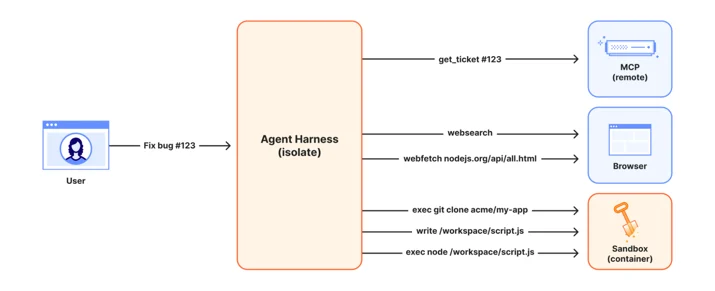
If you build agents for anything beyond chat, you quickly hit the same gap: the agent needs to interact with something that behaves like a user environment, not just call APIs. The naive path is “use a headless browser library and hope the agent can drive it.” That fails in practice because you need a consistent runtime, a defined interface for actions and observations, and a way to sandbox and reproduce behaviors across runs.
cloudflare/computer is a way to “give your agent a computer.” Concretely, it provides an execution environment for browser automation style tasks, so an agent can perform UI actions, not just reason. It is aimed at developer workflows where you want the agent to take actions and observe effects.
What you can take this week is a reference implementation and infrastructure shape for agent execution, including how to wire model decisions to a persistent environment. What it does not establish is scientific evidence of accuracy gains on any benchmark. It is an engineering enabler, so the business question becomes: will your roadmap benefit from tool-like UI execution this quarter, and will enterprises demand governance and deployment specifics around it.
One limitation to keep in mind: without your own sandboxing, logging, and policy layer, a UI-capable agent can be a governance headache. Treat environment control as part of the product, not an afterthought.
When Attention Goes Blind: Numerical Failure in ALiBi Positional Encodings
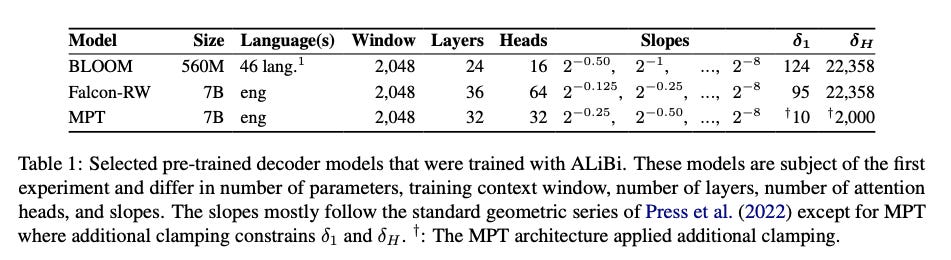
For agents, ALiBi is often “just a drop-in positional encoding,” so teams rarely ask what can go wrong numerically. The naive fix for retrieval issues is to increase context length or tweak decoding. But this paper points to a different class of failure: the linear bias scaling in ALiBi can underflow floating point precision. When that happens, attention weights become zero for a fraction of positions, meaning some heads are partially blind.
The authors identify that ALiBi applies a distance-based bias. For large enough distances, the bias values can underflow, producing zeros in attention computation for affected heads. They then analyze impact on token retrieval, and they also test pretrained models that already use ALiBi, isolating the effect with 148M-parameter decoder models to separate it from general out-of-context degradation.
On results, they report that the ALiBi failure mode can substantially impair token retrieval while only having a minor effect on standard decoder benchmarks. For mitigation, they evaluate four training-time strategies. They find that log-scaled distances yield the most consistent improvements in passkey retrieval. They also note default ALiBi slopes remain a surprisingly strong baseline, especially for needle-in-a-haystack.
Open question: the paper recommends mitigation strategies, but it does not fully pin down how to best decide thresholds and precision settings in your specific stack. If you deploy agents this quarter, you may need to replicate the underflow behavior under your precision and sequence length configurations.
SocietyBench: Forecasting Counterfactual Social-World Evolution
Most agent benchmarks are task completion oriented. That matters, but enterprises are increasingly asking a different question: can the system forecast what happens next in a social or operational environment when surface cues are misleading? The naive alternative is to reuse generic forecasting or sentiment benchmarks, but those often let models lean on memorized entities and dates.
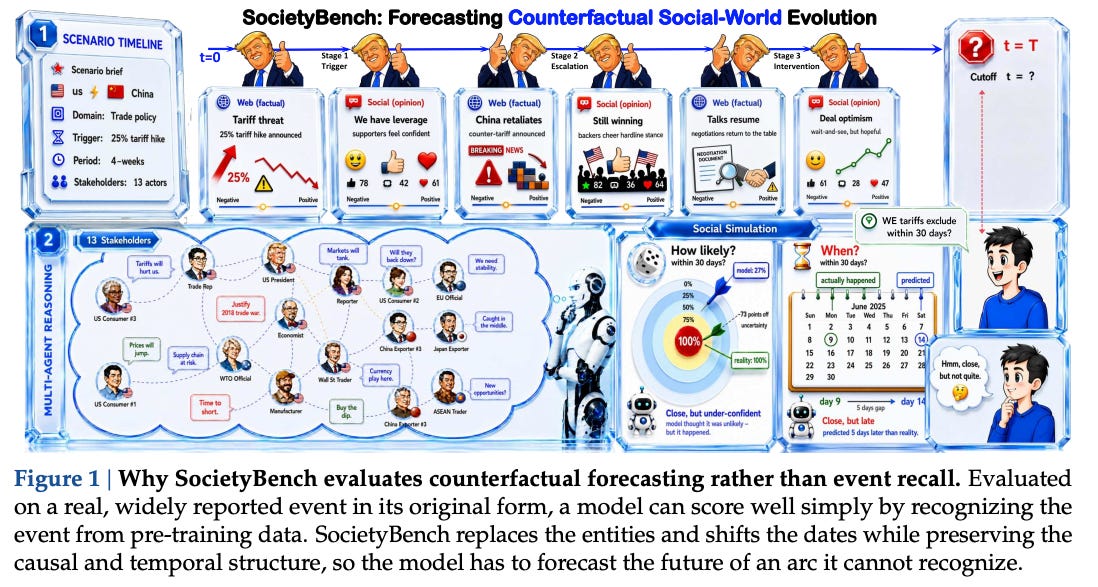
SocietyBench addresses that by building a benchmark that turns a one-line event topic into a timeline of audited forecasting questions. It collects Web news and social media across five platforms, distills them into a date-indexed timeline with factual events separated from a public-opinion layer, and then produces questions at every cutoff date. The key step is counterfactualization. Before a model sees the timeline, a three-phase procedure replaces named entities and shifts dates by a per-event constant. So the arc is structurally similar to what happened, but stripped of the surface labels that models could match from pre-training memory.
The paper states scoring on two orthogonal 100-point axes: probability calibration and temporal accuracy, and it evaluates on five heterogeneous events with 125 prediction points in Chinese and English editions. The artifact excerpt you provided cuts off before full quantitative results, so I cannot responsibly cite their best scores or deltas.
Limitation: because the excerpt ends mid-sentence, I cannot verify the final “strongest of six” result details. Open question for product builders: will enterprises buy this as a forecasting evaluation, or will they demand domain-specific timelines, access control for news sources, and auditability of counterfactual transformations.
Agogic: Performance-Timed Music Tokens for LLM-Native Text-to-Symbolic-Music Generation
Music generation agents highlight a pattern: tokenization decisions get treated as fixed plumbing. The naive approach is to scale the model or tune decoding, assuming the tokenization only affects compression. This paper challenges that by isolating representation choice from model size, data, budget, and decoding.
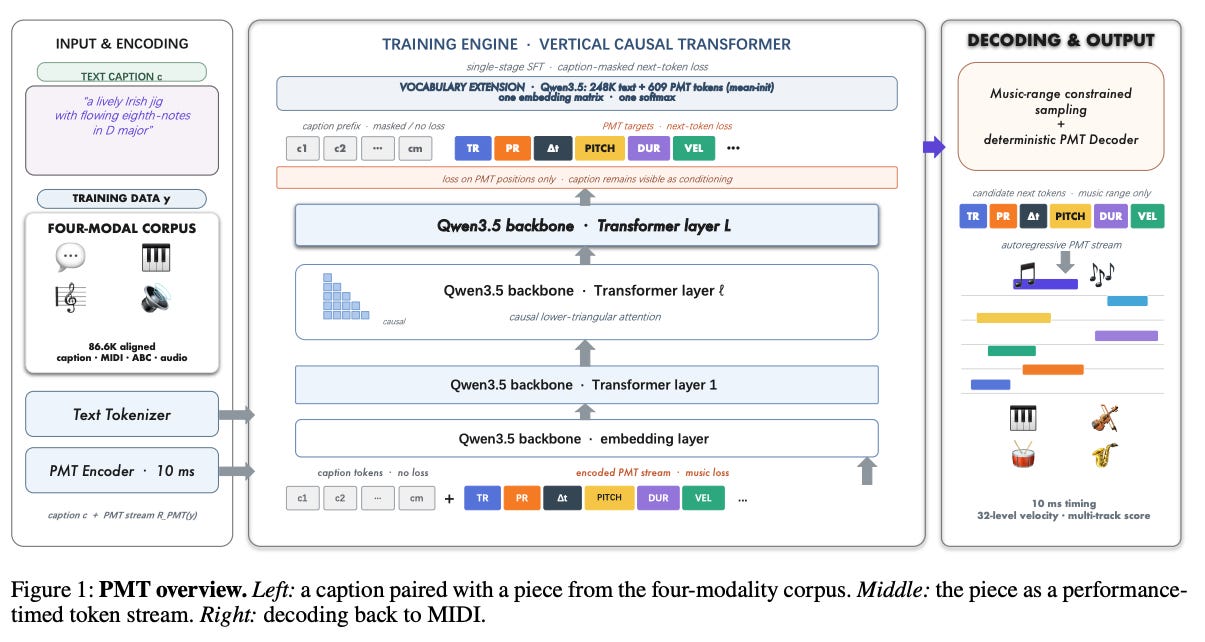
The mechanism is representation ablation with controlled variables. The authors fix pretrained Qwen3.5 (0.8B-27B), hold data and budget constant, and swap only the representation across seven tokenizations. They anchor “texture metrics” to each representation’s model-free ceiling, then compare how performance changes when only tokenization changes. Their proposed representation is PMT, performance-resolution stream, with 10 ms timing, per-note velocity, multi-track texture, and 609 symbols.
Their results: Scaling backbone size 34x barely moves Frechet Music Distance (FMD), while switching representation halves it. They report PMT reaches FMD 159 at 0.8B versus 272-286 for beat grids, described as 1.7x to 1.8x lower, “up to 2.8x elsewhere,” with non-overlapping bootstrap confidence intervals. They also find the property generalizes: it reappears on a 26M from-scratch backbone and with a second performance-resolution tokenizer.
Open question: this is for text-to-symbolic music, not general agent tasks. So the enterprise purchase lever is niche unless your agents include music or creative symbolic domains. Still, the transferable lesson is to treat tokenization or representation as a first-class product lever, not a constant.

Test-Time Scaling in Reasoning LLMs: Inference Regimes, Evaluation, and Reproducibility
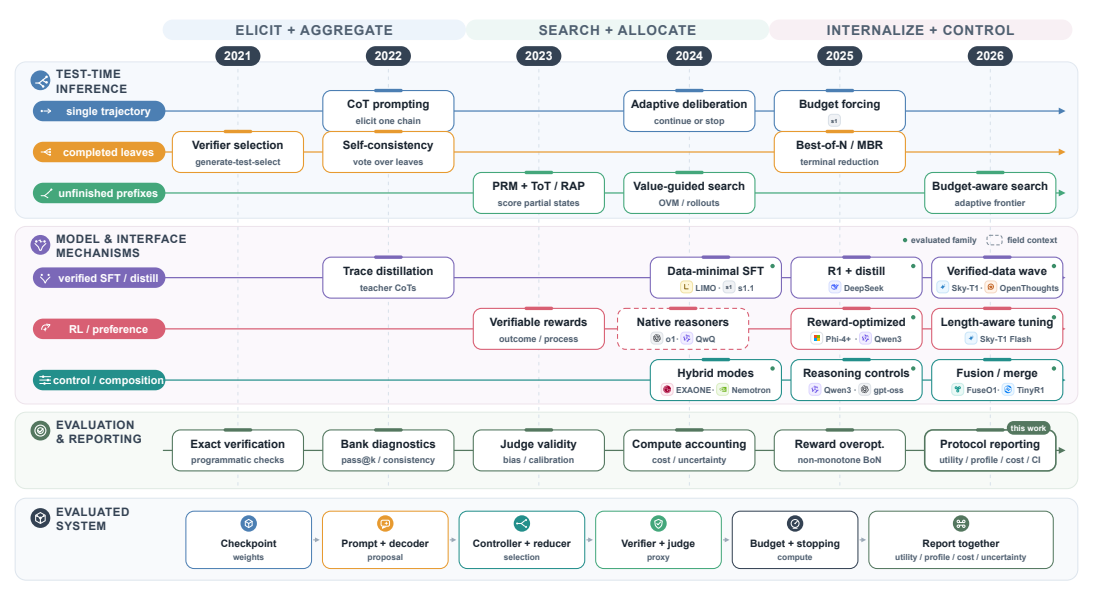
Reasoning LLM research now sells “more compute at inference,” but the term test-time scaling gets used for incompatible methods. The naive fix is to compare reported accuracy across papers using only a scalar “budget.” That fails because inference algorithms differ in statistical structure, compute accounting, and failure modes, so you end up comparing apples to systems.
The paper builds a systematic account of test-time scaling along three axes. First, it formalizes test-time scaling as budgeted inference over the implicit prefix tree of an autoregressive model, and it distinguishes three structural regimes: single-trajectory sequential scaling, leaf-level scaling with terminal reduction, and prefix-level scaling. Second, it treats the evaluated object as the entire inference system and proposes evaluation principles to separate end-to-end system performance from candidate-bank diagnostics.
Limitation: I do not have the full paper results numbers in your provided artifact, so I will not fabricate them. Open question: how the community will adopt these categories consistently when vendors sell “reasoning modes.” For enterprise readiness, expect governance demands around compute metering, reproducibility, and traceable inference protocols.
PAST-Bench: Benchmarking the Foundations of Recursive Self-Improvement in Personal Agents
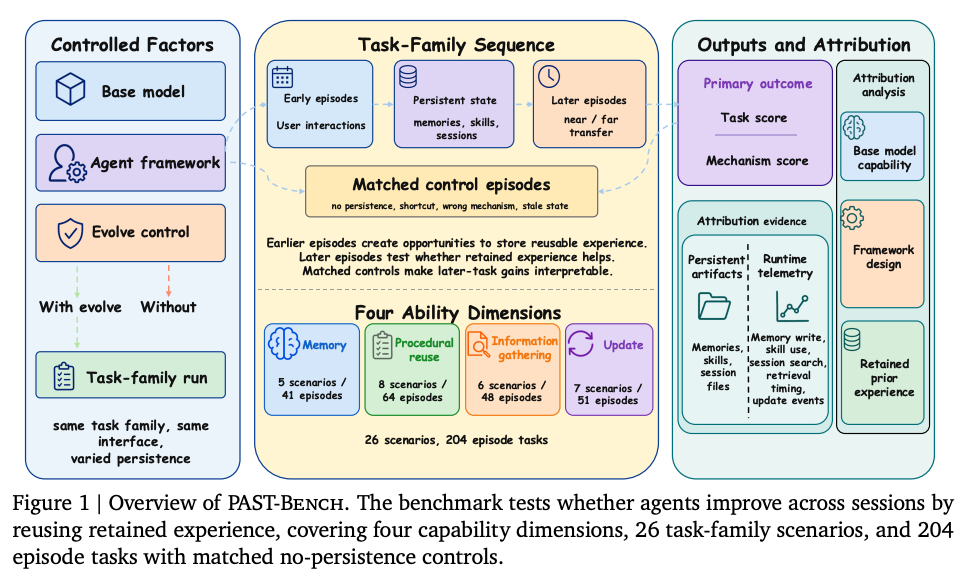
The pitch for personal agents is often “they learn from experience,” which sounds like automatic improvement. The naive test is to measure an aggregate score over time. But that can hide whether improvements come from the intended memory loop or from accidental shortcuts. Enterprises will care because “learning” changes cost, security posture, and governance requirements.
PAST-Bench isolates recursive self-improvement by turning retained experience on and off. Each agent runs through ordered sequences of fresh-session tasks under matched conditions that control whether memory is used. The benchmark spans 26 scenarios and 204 episodes across memory, procedural reuse, information gathering, and update, with metrics for both later-task gains and whether gains follow the intended save-retrieve-update pathway.
The paper evaluates seven base models and four agent frameworks. It reports that improvement is real but uneven across capabilities, and that headline gains can hide pathway failures, meaning different systems can get similar averages while differing in whether the gains are supported by evidence of the intended loop. The excerpt you provided cuts off before the Hermes+ average gain number, so I will not cite it.
Open question: the excerpt does not include the full quantitative Hermes+ outcome. Still, the product implication is immediate for anyone shipping memory features: you should instrument the loop stages and validate that performance gains correspond to expected memory behavior, not just retrieval noise or prompt drift.
A naive fix would be to ship “memory” as a black box. The work’s fix is to benchmark the mechanism, not only the outcome.